Saturday, November 21, 2009

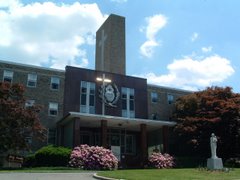
Why I Come to Holy Family


I’m sure you do not need me to tell you why you come to Holy Family. But let me share with you reflections from my own experience. We live in a difficult and changing world, a world that makes demands; creates pressures and forces us into an endless cycle of continuous motion; of running from this thing to that. A world that often imposes cultural values that are at odds with what we believe; with our faith life.

We are engaged in the stressful effort to continue to support our families; to fulfill job commitments and demands; to nurture and support our families; our wives, our children and grandchildren. The need to participate in our church and political communities.

And then there are the personal issues; the surprises that life holds; an illness to a loved one; an unexpected death or injury; or, our own health issues; events which always seem to come at the worst time in our lives. The fragility of life seems to become more apparent as we get older. Or maybe we are just tired, worn out, exhausted and in need of refreshment, a moment of peace, a time to meditate, to pray, to rethink our goals and objectives to reevaluate the direction of our lives.

It is at times like these that Holy Family is there as an oasis in a world of chaos and stress; an island of peace and serenity. We come with all our baggage; and regardless of what we carry, we are accepted as we are into this community of peace and security. We come with our brothers and friends for a period of comradery. We can gather together or be alone as we chose. We can attend informative sessions provided by the retreat team or just rest, if that is what we need. And then there is the spiritual refreshment; the prayer sessions; the liturgy and music ministry; the opportunity for reconciliation.

We come away refreshed, rejuvenated; spiritually alive and ready to meet the challenges of our world or our personal situation with new vigor and firm purpose; encouraged, inspired and filled with hope. This is my experience of Holy Family and this is why I want to ensure that we can continue for the many years to come.

Walter Twachtman

Wednesday, September 9, 2009


On Retreat with Thich Nhat Hanh

I recently attended a six-day retreat led by the Buddhist monk Thich Nhat Hanh. The sessions, which drew 800 people, were held at Stonehill, a Catholic college near Boston. It was my ninth retreat with Nhat Hanh, and each one has been a profound and memorable experience. The Stonehill retreat included talks by Nhat Hanh, small group discussions, meditation and vegan meals eaten in silence.

On the final day, I took part in an early morning ceremony in which I pledged to honor the Five Mindfulness Trainings, which are similar to the Ten Commandments. The five trainings ask us to refrain from killing, stealing, sexual misconduct, lying, and ingesting drugs or alcohol.

The most controversial prohibition turns out to be the one involving alcohol. People on retreat often ask why they should give up alcohol. Two primary reasons are cited. First, liquor clouds the mind and takes us away from the present moment. A central tenant of Buddhism involves the importance of being fully awake and present in each moment of our lives. The second reason involves recognition of the suffering caused by alcohol abuse, a serious addiction that destroys lives and rips apart families.

By not drinking alcohol we say, in effect, that we understand the devastation caused by drinking, and we desire to support those in recovery by not drinking. I was drawn to the Five Mindfulness Trainings, in part, because of their recognition of the damage caused by alcohol. I’m disappointed that the Catholic Church has not always shown a similar awareness about alcohol abuse.

It might surprise some to learn that many Catholics aspire to live by Buddhist principles. It helps to think of Buddhism as a way of life, rather than a religion. The Buddha, who lived 2,500 years ago, discovered principles that can lead to a happier life, with less suffering. Buddhists do not seek converts. Thich Nhat Hanh urges Christians to draw on the spiritual wisdom of their own religion, rather than think about conversion.

Buddhism can deepen one’s spiritual practice, but it never claims to be the sole path to truth and wisdom. Two of Nhat Hanh’s books, Living Buddha, Living Christ and Going Home: Jesus and Buddha as Brothers, focus on the common teachings in the two faiths. Among the Buddhist principles that speak to me are these:

1.Impermanence. Buddhists point to aging, illness and death. Nothing lasts. We all return to dust. Recognition of impermanence helps us to live more joyfully in each moment.

2.Non-attachment. If everything fades, we soon realize how much pain we cause ourselves by clinging to material things, jobs, routines and relationships. We can enjoy everything in the present moment without clinging or attachment.

3.Compassion. This, of course, is no different from what Jesus taught. Buddhists talk about inter-being, the idea that we are all one, in which case war and violence make no sense. Buddhists seek to develop a finely tuned compassion for their own suffering, as well as the suffering of people around the world.

4.Forgiveness. Again, this is what Jesus taught, but it seems to be a difficult concept for many believers. Some people say they can forgive the little slights and hurts, but then draw a line beyond which they cannot forgive. One misconception is that forgiveness excuses harmful acts or crimes, but this is not true because forgiveness is about the person, not the crime. After a horrible crime, forgiveness means we let go of hatred, violence, revenge and anger directed at the perpetrator, who is still loved by God. We do not forgive the crime. That distinction is important.

5.Meditation. Buddhists stress the importance of regular meditation. During meditation, we come home to the present moment. Each time our mind wanders off, we bring it back to this moment. Meditation calms the mind, reduces stress and helps us to live joyfully in each moment. Of course, meditation is not unique to Buddhism. The Catholic priest Thomas Keating has promoted Centering Prayer, a form of meditation similar to Buddhist practice.

Thich Nhat Hanh left his native Vietnam during the Vietnam War. He now lives in France with his fellow monks and nuns at a monastic community called Plum Village, and he has opened monasteries in New York and California. He visits the United States to give retreats every other year.

Ten years ago several of us from the Hartford area attended a retreat with Nhat Hanh in New York, and afterward decided to start a meditation group, which we named the Greater Hartford Sangha. We meet for meditation and sharing in West Hartford every other Tuesday evening at 7:30.

Bill Williams

Bill Williams of St. Helena’s parish in West Hartford hosts the Greater Hartford Sangha. He can be reached at billwaw@comcast.net, or 860-561-3563.

Friday, May 15, 2009

Finding Meaning


I was once invited by a religious education group to present a talk on “Finding Meaning in Everyday Life.” I thought that topic would be a piece of cake—that is, until I started working on what I’d say. To begin with, so much comes to mind when we begin thinking of our every days—getting up on time, making breakfast, getting children off to school, or yourself off to work. That’s the schedule we think of as routine. But then every day life is also about the unexpected, the car breaking down, the alarming phone call, tripping on a rug and taking a bad fall, finding out a good friend has had a stroke, and so on.

So the question in my mind became, how do we find meaning in these daily events, not just the mundane ones, but the life shattering ones? In truth, life has taught me there’s only one way to find meaning in everything we do and experience. We have to find God in all of it. As for how we get to see God in all the minutes of our life, there’s only one way for that to happen, too. We have to have faith, a trust that can be accepted even though it brings no answers for why life goes the way it does.

We have always been taught that faith is a gift, and yet I’ve long had trouble with that. I had struggled with faith and concluded this was not a gift as we ordinarily define it. Rather, it is a relationship with Christ/God. Being a relationship, it has an energy of its own sometimes positive, sometimes negative. But it became clear to me that there truly is a gift. It’s baptism, a wonderful gift, because it brings us to the community—to the place where Christ’s existence comes alive for us. Baptism and faith, then, I saw to be two sides of the same coin.

My heritage is Italian-American. My grandmother often told me that in her home town in Southern Italy, birthdays were not very important, but baptismal days were celebrated each year. For this marked the real birth of a person. I think the Italian celebration of baptism made me understand the complexity of the sacrament. It isn’t something that is done once and then is finished. For it doesn’t end with initiation—the entry of a person into the inner circle of a community, in this case, the Church. Baptism is also immersion, symbolized by the water essential to the sacrament, where a person, or in the case of an infant, the godparents, makes a decision to plunge into the life of Christ, wear his skin, share his work, bear his cross, die with him—so that Christ’s mission of making all people kin will be continued.

Receiving the initial sacrament is no guarantee that a person will choose to accept the continual baptism, the immersion in all the situations to come which demand one’s fidelity to Christ. Baptism, to remain valid has to be lived in all we do—everyday—and that’s where it becomes linked to faith. Keeping faith is a tough call. It requires that we “put on Christ” and live everyday according to Christ’s blueprint, found in every page of the Gospels. If we do, then everyday life, from the mundane to the spectacular to the cross, has meaning.

Antoinette Bosco

Wednesday, March 18, 2009

Maybe It's You

It is almost always the case that we live in uncertain times, but the truth of that statement seems more acute today than it has been in a long while. Our economy is in tatters. After years of reckless and unscrupulous business practices seemed to continue without consequence, we appear to be caught up in a perfect storm of economic events: rising debt, skittish lenders, failing businesses, and growing unemployment lines.

In this storm, it seems that everybody is reeling, looking for shelter. As we look into the face of the uncertainty which these times seem to hold, I am reminded of a passage in Matthew’s Gospel.

You cannot serve God and wealth. “Therefore I tell you, do not worry about your life, what you will eat or what you will drink, or about your body, what you will wear. Is not life more than food, and the body more than clothing? . . . strive first for the kingdom of God and his righteousness, and all these things will be given to you as well. "So do not worry about tomorrow, for tomorrow will bring worries of its own. Today's trouble is enough for today.

In many ways, this scripture passage and the promise that it offers should give us great comfort. But there is something about it which seems almost illusory. And not surprisingly, while we certainly understand this promise, and we understand the importance of putting our faith in this promise, it appears to be one article of our faith that many have a hard time believing. Who really trusts in God so much that they put aside their worries?

In fact, the opposite seems true. For obvious reasons, concerns about money are almost invariably the source of our greatest stress. Though God has promised to care for us and even warned us about being consumed with wealth, we seem chronically unable to heed this warning and to accept this promise on its face. Why is that? I think that the answer is two-fold. First, I think we run a basic cost-benefit analysis and make our choice accordingly. If we put our faith in God to provide for all our needs and we end up being wrong, the consequences are pretty severe. We have no food on our plates, no clothes on our backs and no roof over our heads. So, with respect to our very tangible every day needs, we need the comfort of a tangible way to fulfill those needs. Something that we can trust and rely on coming every pay day.

The other reason that we have such a hard time accepting this promise is that it just seems too good to be true. And there are plenty of examples to back this up, examples of people who seem to have been abandoned. How many have lost their homes in the current financial crisis? How many were displaced by Ike and Katrina? So, I think, it becomes very easy not to place our faith in this promise, or to at least have a reliable back up plan.

So, are those who get up every day and go to work somehow demonstrating a lack of faith in this promise? I don't think so. God gives us many gifts and, I think, expects us to put them to good use. Well, what then do we make of his promise?
Let me offer this. What if we are misunderstanding the promise? Matthew's Gospel tells us, “strive first for the kingdom of God and his righteousness, and all these things will be given to you as well.” I don’t think that God promises to cut our steak when it is tough or to shovel the driveway when the snow is wet and heavy. He promises that when we strive for Him, we will have what we need. Well how is that going to happen?

Well, maybe it’s you. Maybe, when we strive for the Kingdom, we get each others’ backs, we live in communities where people know each other and make soup for each other when we are sick, pick each other up when we are down, stand up for each other when someone needs some help.

God has already told us that he has no hands and feet here on this earth. Your hands are His, your eyes and ears and mouth, His. When we strive for the kingdom, we strive for each other. When we look to find Christ in this world that we might serve Him, we find Him in each other. We see Him naked and we clothe Him, we seem him with no roof and we provide one, we see Him hungry and we prepare a meal to share. We see Him on a rooftop in the Lower Ninth Ward. We see Him looking for work on Bourbon Street.

Maybe it’s us. Maybe it’s me. Maybe it’s you.

So we have this glorious promise. He will care for us. Like He tends to the birds of the air and the flowers of the field, He will watch over us and provide us with what we need. Too good to be true? A pipe dream? Maybe not. Maybe, if we all choose to hear this call to live for others, if we choose to give ourselves away, if we choose to give our hands and feet and eyes and mouth to Christ, maybe then will we realize that God’s promise to us is real, it just requires us to believe in it and to play our part.

He won’t do it alone. Who will help Him? Who is going to do it?

Maybe it’s you.

Chris Haddad

Thursday, January 29, 2009

On Possibility


Many have heard the phrase that “nothing will be impossible with God”. These revered words spoken in Luke’s gospel by the angel Gabriel to Mary are particularly present to us at Christmas time when we reflect on the birth of Jesus. Gabriel tells Mary that her cousin Elizabeth who was thought to be past her child-bearing years is already in her sixth month. Gabriel offers this information to Mary as a kind of “proof” of God’s power and God’s plan for her. Gabriel assures Mary that there is nothing God cannot do. Many will nod in agreement that since it is written in scripture that all things are possible with God then, it must be so.

Yet, for many of us our sense of possibility has diminished in our lives. We feel our lives have been defined, our fate sealed. We rarely consider how powerful our Creator is. Our belief in the boundless creativity of our Creator has been challenged by our disappointments and set-backs. Somewhere along the way we decided how powerful God is for us. Over time, we set limits on how much God can give us or help us and we in turn decide how much we can give and how much we can help ourselves and others.

This has certainly been true in my life. I am so sure I know what I am capable of – what I can accomplish and what is beyond my grasp. Indeed, if all I had to depend on was my own petty strength my assessments on my abilities would probably be accurate. I am reminded how powerful our Creator is as I reflect on the miraculous birth of Jesus. I think about the words spoken to Mary by the angel Gabriel “nothing will be impossible with God.” I notice that Gabriel says with God not for God meaning that when we act with our Creator all things will be possible for us.

The significance of my life has not been settled. My life is not a “done deal” rather it’s more like a work in progress. Everyday I have the opportunity to care for and cherish all that I hold dear. Everyday I have the opportunity to be the person God created me to be. With God, the possibilities are infinite.
The miraculous birth of Jesus - God becoming flesh - is my “proof” that God’s creativity and love is limitless and beyond my understanding. When I pause to reflect on this truth, the possibility that God can mend my strained relationships, comfort me in times of sorrow and inspire me to help others seems, well, entirely possible!

Theresa Wiss,
Director of Youth Ministry

Friday, January 2, 2009

What I Really Believe


I watch what I do to see what I really believe.

Belief and faith are not just words. It's one thing for me to say I'm a Christian, but I have to embody what it means; I have to live it. So, writing this essay and knowing I'll share it in a public way becomes an occasion for me to look deeply at what I really believe by how I act.

"Love your neighbor as yourself," Jesus said, and as a beginner nun I tried earnestly to love my neighbor — the children I taught, their parents, my fellow teachers, my fellow nuns. But for a long time, the circle of my loving care was small and, for the most part, included only white, middle-class people like me. But one day I woke up to Jesus' deeper challenge to love the outcast, the criminal, the underdog. So I packed my stuff and moved into a noisy, violent housing project in an African-American neighborhood in New Orleans.

I saw the suffering and I let myself feel it: the sound of gunshots in the night, mothers calling out for their children. I saw the injustice and was compelled to do something about it. I changed from being a nun who only prayed for the suffering world to a nun with my sleeves rolled up, living my prayer. Working in that community in New Orleans soon led me to Louisiana's death row.

So, I keep watching what I do to see what I actually believe.

Jesus' biggest challenge to us is to love our enemies. On death row, I encountered the enemy — those considered so irredeemable by our society that even our Supreme Court has made it legal to kill them. For 20 years now, I've been visiting people on death row, and I have accompanied six human beings to their deaths. As each has been killed, I have told them to look at me. I want them to see a loving face when they die. I want my face to carry the love that tells them that they and every one of us are worth more than our most terrible acts.

But I knew being with the perpetrators wasn't enough. I also had to reach out to victims' families. I visited the families who wanted to see me, and I founded a victims’ support group in New Orleans. It was a big stretch for me, loving both perpetrators and victims' families, and most of the time I fail because so often a victim's families interpret my care for perpetrators as choosing sides — the wrong side. I understand that, but I don't stop reaching out.

I've learned from victims' families just how alone many of them feel. The murder of their loved one is so horrible, their pain so great, that most people stay away. But they need people to visit, to listen, to care. It doesn't take anyone special, just someone who cares.

Writing this essay reminds me, as an ordinary person, that it's important to take stock, to see where I am. The only way I know what I really believe is by keeping watch over what I do.

Sr. Helen Prejean, C.S.J

Monday, December 1, 2008

Saved by Hope


In the encyclical “Saved by Hope” which Pope Benedict issued close to a year ago, he asks some disturbing questions. “How could the idea have developed that Jesus’ message is narrowly individualistic and aimed only at each person singly?” It’s as though the Pope were saying, “Where in the world did that idea come from?” And he goes on in the same vein as though in exasperation at such a distortion of what the message of Jesus is: “How did we arrive at this interpretation of the salvation of the soul as a flight from responsibility for the whole and how did we come to conceive the Christian project as a selfish search for salvation which rejects the idea of serving others?”

In his address to the bishops of the United States in April of this year at the Basilica of the National Shrine of the Immaculate Conception in Washington, D.C., Pope Benedict stated the same problem in the affirmative. He said, “Any tendency to treat religion as a private matter must be resisted. Only when their faith permeates every aspect of their lives do Christians become truly open to the transforming power of the Gospel.”

This misunderstanding, this privatizing of the faith, is something all of us are vulnerable to. However, in the United States with its culture of individualism, with the way we lionize the “self-made” person with all that term suggests by way of going it alone and an unregulated autonomy make us particularly susceptible to this distortion of what it means to be a follower of Jesus.

The Pope was not expressing a pet peeve or some kind of idiosyncratic beef. Ingredient to the gospel preached and lived by Jesus is the understanding that we are all interrelated and interconnected and called to serve even as Jesus came not to be served but to serve and to give.. Jesus has not been called The Man for Others because he isolated himself from his contemporaries or was indifferent to the human condition. To trace this reality even farther back, at the very beginnings of God’s dealing with humanity; God was not pleased with Cain’s response to the question, “Where is your brother?” “Am I my brother’s keeper?” Cain should have known better and, certainly by now, so should we.

As the followers of Jesus, we cannot hold ourselves aloof from the condition of our brothers and sisters in the family of God, nor is it permitted us to be disinterested and detached from what is happening to Earth, our home. The imperative from our baptism is to get ourselves involved.

First of all by prayer, yes. The prayer for enlightenment as to where we can best serve the human family, where we can best be those channels of the values of the reign of God. Prayer, too, for our own transformation of heart that we may be unselfseeking and involve ourselves in a self-emptying way that the Spirit flowing through us will empower those we serve.

But, then, to really get ourselves engaged, to be willing to leave our own comfort zone, to get our hands dirty, to share with others whatever we have to share, whether materially, emotionally, spiritually as the case and the demand may be. To do this with a certain spirit of abandon, not even looking for results, with the faith conviction that, if we serve in this fashion, the Spirit of God flowing through us will produce its own fruit at the proper time.

This calls not for a knee-jerk response but for reflection with other like-minded citizens of this planet, preferring always cooperation over competition. There is no telling how much good can be done if we would not concern ourselves with who will get the credit! To study or engage with others who have studied societal or ecological problems to discover what structures in our society have to be changed or done away with if we are to have the just society we all are hungry and thirsty for is a part of this involvement and living out our commitment as incorporated into the Christ who lives in the world today.

One does not have to be a philanthropist in order to enrich others (and it may be observed, be enriched ourselves in the process), we have only to draw upon the inheritance that is ours as alive with the life of the risen Lord in whom are all the treasures of wisdom and knowledge, in whom dwells the fullness of divinity which we share by the life of grace! We have been given a wild tiger that we have tamed into a cuddly pussy cat. This season of Advent-Christmas season when we celebrate the birth of him who through his union with one of us has taken up his abode in all of us may be an excellent time to arouse this reality from its torpor! And truly acknowledge the presence of him who has never left us by his presence in our fellowman and woman!

Fr. John Baptist Pesce, C.P.